News

News

March 24, 2026

ABE research team: Purdue research team wants to harness AI to secure corn crops from pathogenic threats

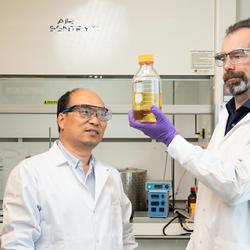
A research team at Purdue University’s colleges of Agriculture and Engineering aims to ensure the security of the nation’s corn crops by using artificial intelligence as an early warning system.

The team is using cutting-edge technological advances and research infrastructure to pursue the project with a nine-month, $450,000 contract from the United States Defense Advanced Research Projects Agency (DARPA).
March 24, 2026

Ambrose: Grain dust explosion incidents decrease, fatalities increase

The number of explosions is slightly below the 10-year national average of 8.5 and down from the nine that occurred in 2024. Even though there were fewer explosions, the number of injuries and fatalities increased compared to two injuries and no fatalities in 2024.
March 24, 2026

Thiagarajan: Lilly Scholar Jason Thiagarajan finds his path to pharmaceutical engineering at Purdue

When Jason Thiagarajan was weighing his college options, he wasn’t sure how he would pay for school, or which university would best prepare him for life and career. That uncertainty disappeared the day he opened his acceptance letter to Purdue University.

Inside was an invitation to join the inaugural cohort of the Lilly Scholars at Purdue (LSAP), a program that covered his full tuition and created a direct talent pipeline to one of the world’s leading pharmaceutical companies. For Thiagarajan, a junior in agricultural and biological engineering from Bloomington, Indiana, it was the clarity he had been seeking.
March 3, 2026

Sankar: Drawing inspiration from nature to formulate new pharmaceuticals

Karthik Sankaranarayanan trained in two quite different scientific subfields as a graduate student and as a postdoctoral researcher. Now at Purdue University, he aims to combine those fields in a project that will use artificial intelligence to plan the synthesis of complex new pharmaceutical agents.

“Nature uses enzymes to effortlessly produce her complex small molecules. The pharmaceutical industry is increasingly interested in using enzymes to synthesize molecules that may be challenging to produce using traditional organic chemistry,” said Sankaranarayanan, an assistant professor of agricultural and biological engineering. With that in mind, he will design an AI algorithm to sift through the diverse set of enzymatic reaction chemistries that nature uses to produce molecules.
March 2, 2026

Verma: Portable device detects pathogens’ diverse settings

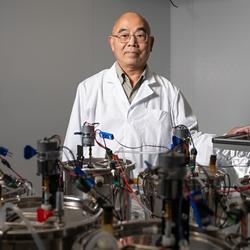
Purdue University researchers have developed a device for more conveniently detecting pathogens in health care settings, on farms and in food production operations.

Nafisa Rafiq, a PhD student in biomedical engineering, and Mohit Verma, associate professor of agricultural and biological engineering, described their new system in the IEEE Sensors Journal. Rafiq, Verma and Bibek Raut, also a PhD student in biomedical engineering at Purdue, have submitted a patent application for related technologies. Verma serves as chief technology officer of Krishi, a startup company that develops molecular assays.
March 2, 2026

Lowe: Purdue Agriculture athletes honored for academic performance

Two Purdue Agriculture student athletes were named Academic All-Big Ten Honorees for the fall sports season. The Academic All-Big Ten team recognizes student athletes' outstanding classroom performance with a GPA of 3.0 or higher. Both Quintin Lowe and Julia Kane are multi-year honorees.
March 2, 2026

Kessinger: From Boilermaker spirit to biopharma breakthroughs

Growing up in Indiana, Emma Kessinger was no stranger to the rigor and prestige that come with a Purdue University degree. When she decided to pursue engineering, Purdue quickly stood out as the clear choice, offering both frozen in-state tuition and one of the nation’s top engineering programs. Just as important to Emma, though, was the culture.
March 2, 2026

Wolf: My victory: Building a research team from scratch

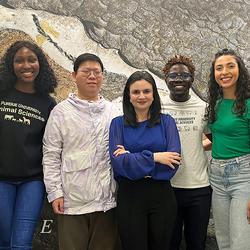
Amanda Wolf spent an entire semester cold-calling faculty members across Purdue, pitching what must have sounded like an absurd idea: Could a team of undergraduate peer learners work in a biological lab together, receiving regular genetic engineering mentorship despite having no formal training?

The conversational dead-ends piled up. Faculty after faculty said no. But Wolf had a strategy. She turned every rejection into opportunity by asking for referrals. "I asked all around Purdue, using the research connections of my peers and friends," she recalls. "While naturally there were a lot of no's, I was able to turn every no into more possible connections just by asking for referrals."
Viewing 1 to 10 of 10