News

News

March 3, 2026

Sankar: Drawing inspiration from nature to formulate new pharmaceuticals

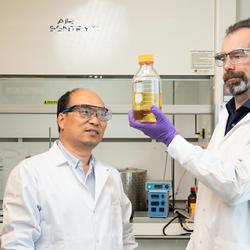
Karthik Sankaranarayanan trained in two quite different scientific subfields as a graduate student and as a postdoctoral researcher. Now at Purdue University, he aims to combine those fields in a project that will use artificial intelligence to plan the synthesis of complex new pharmaceutical agents.

“Nature uses enzymes to effortlessly produce her complex small molecules. The pharmaceutical industry is increasingly interested in using enzymes to synthesize molecules that may be challenging to produce using traditional organic chemistry,” said Sankaranarayanan, an assistant professor of agricultural and biological engineering. With that in mind, he will design an AI algorithm to sift through the diverse set of enzymatic reaction chemistries that nature uses to produce molecules.
March 2, 2026

Monnin: Growing A Future in Agrosecurity

For Andrew Monnin, a student from Cicero, Indiana, Purdue Agriculture felt like the right fit from the start. Planning to graduate in December 2026, he is majoring in agricultural systems management (ASM) with a concentration in agrosecurity.

“I chose Purdue Agriculture because of its internationally recognized status and the opportunity to learn from some of the greatest experts in the world,” he said. “When I discovered the agrosecurity concentration, I knew ASM was the major for me. It combines my fascination with complex agricultural systems and my interest in safety and security, all while providing the hands-on learning experiences I love.”

He describes the Department of Agricultural and Biological Engineering (ABE) as a place where faculty are approachable and invested in their students.
March 2, 2026

Verma: Portable device detects pathogens’ diverse settings

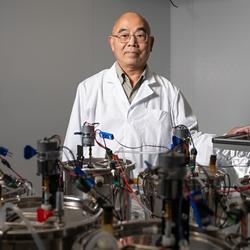
Purdue University researchers have developed a device for more conveniently detecting pathogens in health care settings, on farms and in food production operations.

Nafisa Rafiq, a PhD student in biomedical engineering, and Mohit Verma, associate professor of agricultural and biological engineering, described their new system in the IEEE Sensors Journal. Rafiq, Verma and Bibek Raut, also a PhD student in biomedical engineering at Purdue, have submitted a patent application for related technologies. Verma serves as chief technology officer of Krishi, a startup company that develops molecular assays.
March 2, 2026

Lowe: Purdue Agriculture athletes honored for academic performance

Two Purdue Agriculture student athletes were named Academic All-Big Ten Honorees for the fall sports season. The Academic All-Big Ten team recognizes student athletes' outstanding classroom performance with a GPA of 3.0 or higher. Both Quintin Lowe and Julia Kane are multi-year honorees.
March 2, 2026

Wolf: My victory: Building a research team from scratch

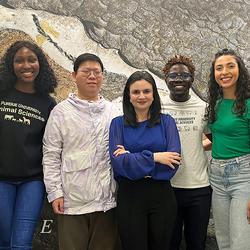
Amanda Wolf spent an entire semester cold-calling faculty members across Purdue, pitching what must have sounded like an absurd idea: Could a team of undergraduate peer learners work in a biological lab together, receiving regular genetic engineering mentorship despite having no formal training?

The conversational dead-ends piled up. Faculty after faculty said no. But Wolf had a strategy. She turned every rejection into opportunity by asking for referrals. "I asked all around Purdue, using the research connections of my peers and friends," she recalls. "While naturally there were a lot of no's, I was able to turn every no into more possible connections just by asking for referrals."
March 2, 2026

Kessinger: From Boilermaker spirit to biopharma breakthroughs

Growing up in Indiana, Emma Kessinger was no stranger to the rigor and prestige that come with a Purdue University degree. When she decided to pursue engineering, Purdue quickly stood out as the clear choice, offering both frozen in-state tuition and one of the nation’s top engineering programs. Just as important to Emma, though, was the culture.
November 5, 2025

Kaur: Tracking ticks and tackling disease: AI transforms medical entomology

A robot “dog” may soon make its way from a Purdue entomology lab to fetch real-time data on tick populations in the wild.

It’s just one example of how artificial intelligence (AI) is transforming medical entomology by offering innovative ways to track, analyze and control the insect populations that affect human, animal and environmental health.

Researchers in the Department of Entomology in Purdue University’s College of Agriculture are at the forefront of the field. They’re advancing the university’s One Health initiative as they use AI in new ways to study mosquitoes, ticks, cockroaches, bed bugs and other arthropods.
Tracking tick populations is essential for controlling the spread of tickborne diseases, but it’s not a straightforward task. That’s why Hill, alongside Maria Murgia, postdoctoral researcher in the entomology department, and Upinder Kaur, assistant professor in the Department of Agricultural and Biological Engineering (ABE), are combining AI, robotics and entomology for an innovative approach to tracking ticks.
November 5, 2025

ASM Club: Purdue's ASM Club helps students forge connections beyond the classroom

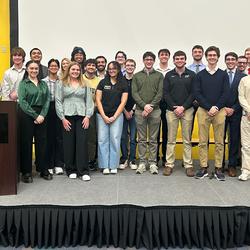
For many students, campus clubs open the door to connections. The Agricultural Systems Management Club stands out as a place where students not only find community but also build a legacy—one that has been a part of the Boilermaker community for more than 50 years. Concerned about the club decreasing in size and impact, student leaders have committed to its revitalization.
November 5, 2025

Verma: Light-based tool continuously monitors vaccine quality during production

The outbreak of the COVID-19 pandemic demonstrated the need to rapidly develop, produce and distribute large quantities of new vaccines. A team of researchers at Purdue University and Merck & Co. Inc., known as Merck Sharp & Dohme Corp. outside of the U.S. and Canada, has now introduced a new analytical tool that could help pharmaceutical companies boost vaccine production with rapid monitoring and analysis.

The research team, led by Mohit Verma, associate professor of agricultural and biological engineering at Purdue, validated the patent-pending tool in tests that successfully measured the quality and quantity of continuously flowing viral particles.
October 20, 2025

AgBridge 2025: Bringing digital agriculture to middle and high school classrooms

Digital technologies are rapidly developing to solve the world’s most pressing problems, and middle and high school students are eager to try their hand using them. Schools, however, may not have access to the right equipment, and teachers may struggle to find a way to fit digital content into curriculum standards without being familiar with the technology themselves.

“There is a rural digital gap,” Yaguang Zhang, clinical assistant professor in Online Education, Agricultural Sciences, Education and Communication, and Agricultural & Biological Engineering, said. “Small towns struggle a lot in getting materials and teaching support. Some of the students will have trouble in rural areas doing homework digitally.”
Viewing 1 to 10 of 601 | Next 10 >