
Purdue project to study the durability of neutron-irradiated 3D-printed nuclear materials earns DOE support
Purdue project to study the durability of neutron-irradiated 3D-printed nuclear materials earns DOE support
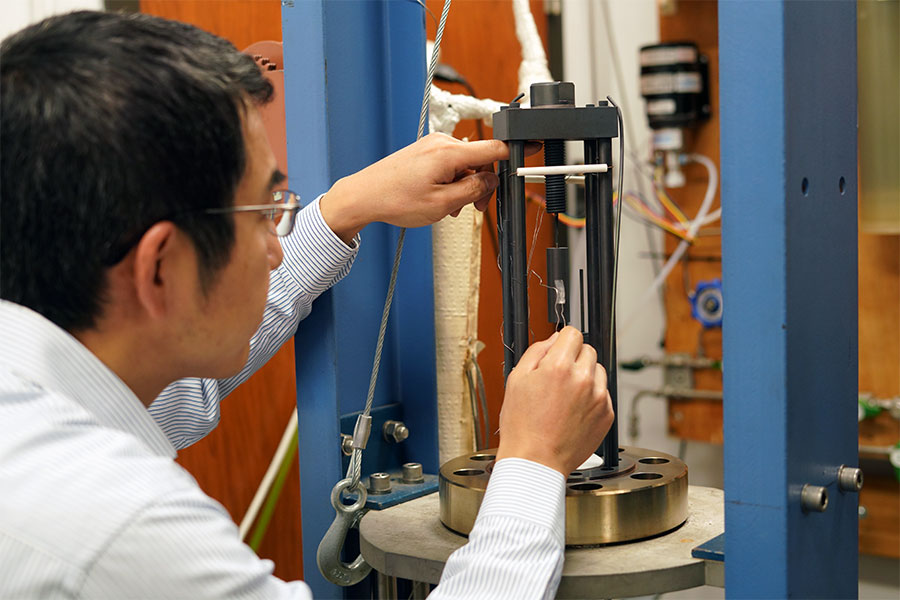
A research project at Purdue University, funded by the U.S. Department of Energy (DOE) Nuclear Energy University Program (NEUP) and supported through the Nuclear Science User Facilities (NSUF), will examine how additively-manufactured (AM) components perform in the extreme environments of nuclear reactors, addressing a key question in the future of advanced nuclear energy systems. The three-year project includes $1.1 million in R&D funding, with additional NSUF funding provided through access to national laboratory facilities.
The project, "Understanding neutron irradiation-assisted stress corrosion cracking mechanisms of 316L stainless steel made by laser additive manufacturing," will focus on the long-term performance of additively manufactured stainless steel in neutron-irradiated nuclear environments, with particular emphasis on irradiation-assisted stress corrosion cracking (IASCC).
As nuclear energy technologies evolve, additive manufacturing—commonly known as 3D printing—is gaining attention as a faster, more flexible way to produce and repair reactor components. However, before these materials can be widely adopted, researchers must better understand how they behave under the combined stresses of radiation, high temperatures, and corrosive environments.
“We want to understand whether 3D-printed materials respond differently compared to traditional materials under these conditions,” said Xiaoyuan Lou, who is the project leader and associate professor in the Purdue School of Nuclear Engineering. “Even if the alloy composition is similar to conventional forged components, 3D-printed materials exhibit vastly different microstructure that can change how a material behaves in nuclear reactors. Our goal is to identify potential risks and understand the mechanisms behind them so these materials can be used safely.”
Neutron data is the golden standard for U.S. Nuclear Regulatory Commission (NRC) to certify nuclear materials. To investigate, the research team will analyze neutron-irradiated samples previously exposed to Advanced Test Reactor (ATR) at Idaho National Laboratory (INL) and compare them with non-irradiated and proton-irradiated materials studied at Purdue. Because irradiated materials must be handled in specialized facilities, much of the experimental work will take place at DOE national laboratories using advanced imaging and characterization tools. Students will travel to these facilities to participate in experiments, data collection, and analysis, gaining hands-on experience with advanced nuclear research infrastructure.
The findings are expected to provide data and fundamental science to support the qualification of additive manufacturing for light water and small modular nuclear reactors, and help address safety and reliability considerations for nuclear components. In addition to advancing research, the project will provide training opportunities for students at both the graduate and undergraduate levels.
Project collaborators include Janelle Wharry of the University of Illinois Urbana-Champaign; Wen Jiang of North Carolina State University; Jun-Sang Park of Argonne National Laboratory; and Ramprashad Prabhakaran of Pacific Northwest National Laboratory. In addition to the R&D funding, the project is also granted NSUF funding to get access to the NSUF facilities at Argonne National Laboratory and Pacific Northwest National Laboratory, and High-Performance Computing at Idaho National Laboratory. Technical leads in these facilities including Xuan Zhang and Yiren Chen of Argonne National Laboratory and Stuart Malloy of Pacific Northwest National Laboratory will provide experimental and administrative supports. These collaborators will conduct experiments, contribute expertise in irradiated material testing, advise students, and provide access to specialized facilities critical to the project’s experimental work.