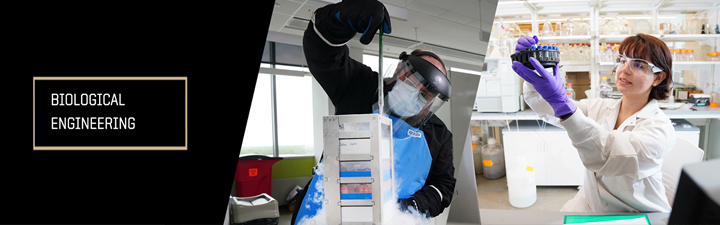
Biological systems are at the heart of solutions to problems related to the
environment, energy, health, food, and sustainability. Biological engineering
graduate students use tools, either through computation and modeling or
instrumentation and biological and biochemical methods, to create and
manipulate cells and cellular materials for a variety of applications relating
to human, plant, and animal systems. This emerging field is expected to
rapidly advance and open opportunities in biomanufacturing, biosensors,
microbiome, biomaterials, human therapeutics, tissue and organ regeneration,
computational genomics, high-throughput sequencing algorithms, bioenergy and
biofuel production, bioremediation, and biodefense.
Faculty
Somali Chaterji
Associate Professor, Agricultural & Biological Engineering
Research Areas
Innovatory for Cells and Neural Machines (ICAN)
straddles the domains of digital agriculture (IoT & scalable
databases) and computational biology (ML for genomics & cell
engineering), both of which use applied machine learning,
scalable databases and cloud/edge computing.
https://schaterji.io
Kari Clase
Professor, Agricultural & Biological Engineering
Research Areas
Biotechnology Innovation and Regulatory Science Center
leader, developing global programs to ensure sustainable access
to medicines in Africa and advance discovery in manufacturing
technology, quality of medicines, and rare disease research.
Abigail Engelberth
Associate Professor, Agricultural & Biological Engineering,
Environmental & Ecological Engineering
Research Areas
Bioseparations to recover valuable co-products
from underutilized biological resources and the design of the
recovery processes to assess potential economic feasibility of a
given co-product.
https://engineering.purdue.edu/ERG
Michael Ladisch
Distinguished Professor of Agricultural & Biological
Engineering; Director, Laboratory of Renewable Resources
Engineering
Research Areas
Bioseparations & Mass Transfer: liquid
chromatography, membrane separations, microfluidics, injectable
biologics. Pathogen Detection. Biocatalysis: enzymes, cellulose
pretreatment, fermentation, process engineering.
https://www.purdue.edu/lorre/
Martin Okos
Professor, Agricultural & Biological
Engineering/Biochemistry, and Food Process Engineering
Research Areas
Optimization of food, pharmaceutical and bio processes using experimental and computer-aided research. Measurement of
rheological, transport and kinetic properties, Design of
biological fermentation, extrusion, dehydration and separation
systems.
Marshall Porterfield
Professor, Agricultural & Biological Engineering
Research Areas
Biosensors. Lab-on-a-chip MEMS devices for cell
sensing. Biomimetic sensors for environmental monitoring
Bio-nanotechnology. Bioregenerative Life Support.
Nutrient delivery systems for use in microgravity.
Caitlin Proctor
Assistant Professor, Agricultural & Biological Engineering,
Ecological & Environmental Engineering
Research Areas
Microbial ecology of aquatic systems. Improving
systems to enhance functionality and protect public health
(e.g., in drinking water) by understanding the dynamic
ecosystems happening on small scales.
Kurt Ristroph
Assistant Professor, Agricultural & Biological Engineering |
Chemical Engineering (courtesy)
Research Areas
Scalable nanomaterials for medical and agricultural
applications.
Controlled drug delivery in humans, plants, and animals. Plant
bionanotechnology, translational nanomedicine, soft material
science, process scale-up, pathogen targeting.
http://www.ristrophlab.com
Karthik Sankaranarayanan
Assistant Professor, Agricultural & Biological Engineering
Research Areas
Applied data science for enzymology. We
develop computational models for enzyme reaction chemistry to
make experimentally testable predictions for addressing
manufacturing challenges associated with complex synthetic
molecules that are important to the society (e.g.,
pharmaceutical agents, agrochemicals, and food flavoring).
https://www.ksankargroup.com/
William Scott
Assistant Professor, Agricultural & Biological Engineering
Research Areas
Biological Engineering; Food, Pharmaceutical, and Biological
Process Engineering; Data Science and Digital Agriculture.
David Umulis
Dane A. Miller Head and Professor, Biomedical
Engineering/Professor, Agricultural & Biological
Engineering
Research Areas
Systems Biology. Interdisciplinary research:
mechanisms of development and regulation of Bone Morphogenetic
Proteins. Finite-element modeling of biological systems.
Quantitative image analysis, microscopy, and data-driven
modeling.
https://engineering.purdue.edu/~dumulis
Mohit Verma
Associate Professor, Agricultural & Biological
Engineering
Research Areas
Engineering microbiomes. Field-deployable
paper-based microfluidic biosensors for animal health and
human health, in vitro models for studying host-microbiome
interactions, ecological rules of life, soft materials and
devices.
https://www.vermalab.com