ECE sophomore Ferrer helps students navigate college workload as ESC tutor
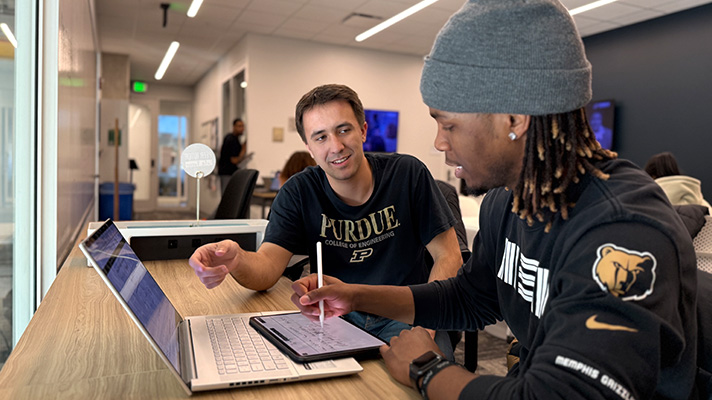
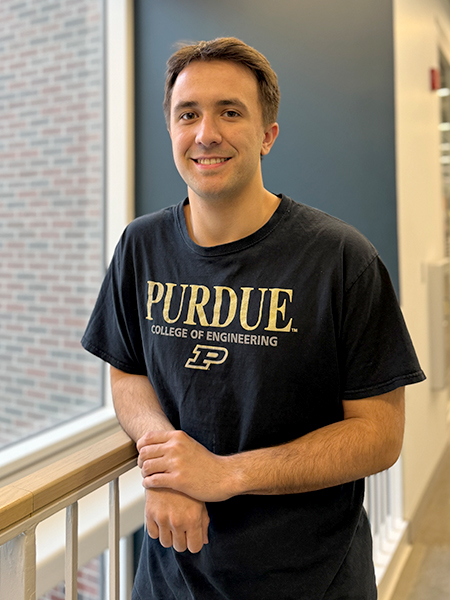
Luke Ferrer was not prepared to give a full lecture on electrical engineering.
So he was relieved to find out that helping a student as a tutor was not at all like a lecture hall. Ferrer, a sophomore, was totally new to tutoring when he was hired as one for the Engineering Success Center (ESC) in January 2026.
“When I started, I thought tutors would provide second lectures to students,” said Ferrer, an electrical engineering student from Washington, D.C. “That made me nervous: I don’t quite remember everything from all my classes. But when I started actually tutoring, I realized students come in with questions and I ask them questions to help them come to the solutions themselves.”
Tutoring is much more guidance than giving answers, Ferrer discovered. Instead of being an answer supplier, the tutoring process reveals tools and make connections that will empower students to succeed “when the guardrails are taken off.”
Watching students navigate the maze of understanding algebra or engineering principles — and eventually finding solutions with less help each time — excites Ferrer. To be the best tutor for each student, Ferrer begins sessions by asking students to explain the problem or concept in question to the best of their ability.
“Oftentimes when people explain things out loud, they see that they know more than they thought,” Ferrer said. “From there, I ask them to walk me through how they solve a practice problem, and that helps both of us figure out where the confusion is.”
Though only one month into tutoring, Ferrer has watched students start sessions totally overwhelmed and end an hour later with newfound confidence and independence. Students who have sought Ferrer’s help regularly in those weeks have grown so much that he calls their sessions “emotional support” because students solve problems without any extra help while Ferrer sits by.
That’s the ultimate goal in tutoring. A little early guidance in a study room can go a long way on a later exam. Don’t wait until a problem feels impossible to approach tutoring, Ferrer encourages: Tackle questions early on by reading notes and then trying a practice exam.
Then looking at notes, then doing a practice exam. Again and again.
“If you rotate between looking at your notes and taking a practice exam, it can help you see where you understand things and where to focus studying a bit more,” Ferrer said. “It also gives you a strong understanding of what the exam will be like and how to pace yourself.”
The cyclic switch between studying and applying was something Ferrer learned during Engineering Academic Boot Camp (EABC) that he recommends highly.
Ferrer was grateful to have had the realization in July 2024 instead of September 2024 that college homework takes a lot longer than high school homework, thanks to EABC. High school meant Ferrer was doing practice problems for 30 minutes after school; College homework took several daily stints of hours-long preparation, practice and checking work.
“EABC throws you into college immediately,” Ferrer said. “One of my first assignments was reading chapters of a textbook and answer (some) reading comprehension questions, which was something I’d never done in high school. It was a significant jump and an important skill I needed for college.”
After successfully navigating the shift from high school to college, Ferrer now aids students in making the jump by tutoring comprehension-heavy subjects like ECE 20001 (Electrical Engineering Principles) and MA 26500 (Linear Algebra).
And somehow, in a sophomore year full of tutoring, classes, a VIP project, an Industry Knowledge Certificate in Semiconductors and Microelectronics and clubs — Ferrer still makes substantial time throughout the day both to do homework and to take his own advice: notes, exam, repeat.
The Engineering Success Center houses a collaborative learning environment through tutoring, faculty-led concept deep dives and exam preparation sessions. ESC provides a physical space for students to study, ask questions and learn together with 17 available tutors in over 40 engineering and engineering-related subjects. Located in Lambertus 2235, the area is open to students from 8 a.m.-8 p.m. for teamwork and individual study.