August 26, 2016
News
News
August 25, 2016
Purdue University researcher led a team that is a finalist for the 2016 R&D 100 award
Purdue University researcher led a team that is a finalist for the 2016 R&D 100 award, which has been called the "Oscars of invention."
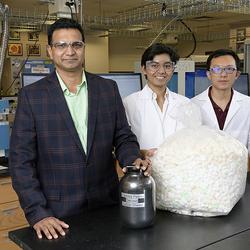
The team has developed a process to convert trashed packing peanuts into carbon for battery electrodes and also for a technology to capture carbon dioxide from the atmosphere to reduce climate change. The carbon nanoparticles and “microsheets” are produced at low cost from polystyrene and starch-based packing peanuts, respectively, said Vilas G. Pol, an associate professor in the School of Chemical Engineering and the School of Materials Engineering.
The team has developed a process to convert trashed packing peanuts into carbon for battery electrodes and also for a technology to capture carbon dioxide from the atmosphere to reduce climate change. The carbon nanoparticles and “microsheets” are produced at low cost from polystyrene and starch-based packing peanuts, respectively, said Vilas G. Pol, an associate professor in the School of Chemical Engineering and the School of Materials Engineering.
August 11, 2016
DOE grant supports work at Purdue on improving aluminum
The U.S. Department of Energy has awarded a grant to a Purdue University professor in the College of Engineering working on the characteristics of metals.
July 25, 2016
Congratulations Matthew Krafcik, an MSE Ph.D. student advised by Prof. Kendra Erk.
Matthew Krafcik, a Ph.D. student advised by Prof. Kendra Erk, received a best poster award at the 7th annual Cements Division meeting of The American Ceramics Society, held at Northwestern University from July 10-13, 2016.

June 15, 2016
John Rotella - 2016 NDSEG Research Fellowship
John Rotella, a 2nd year PhD candidate in Materials Engineering, won a 2016 NDSEG Research Fellowship. This prestigious award provides full support for his stipend and tuition for up to 3 years during the remainder of his PhD studies.

May 17, 2016
Perovskites Key to New Type of Hydrogen Fuel Cell
Crystals known as perovskites promise to revolutionize solar cells. Now researchers have found that they could improve fuel cells as well.
Fuel cells convert the chemical energy stored in fuels such as hydrogen into electricity. They do so by reacting the fuel with oxygen or another oxidizing agent that can strip electrons from the fuel. An electrolyte—commonly a polymer or ceramic—interposed between the fuel and oxidizer helps shuttle ions within the fuel cell.
Fuel cells convert the chemical energy stored in fuels such as hydrogen into electricity. They do so by reacting the fuel with oxygen or another oxidizing agent that can strip electrons from the fuel. An electrolyte—commonly a polymer or ceramic—interposed between the fuel and oxidizer helps shuttle ions within the fuel cell.
May 13, 2016
U.S. Army Ordnance Corps Hall of Fame
Mr. Carmine Spinelli has achieved an extraordinary pattern of leadership and excellence during his 40-year career. He became a member of the Senior Executive Service in 1990. Mr. Spinelli served as the Deputy Director, U.S. Army Fire Support Armaments Center (FSAC) (currently called Munitions Engineering Technology Center (METC) from 1990 to 1995. During his tenure, he managed an organization of more than 1000 scientists and engineers involved in the research, development, and engineering of a variety of armaments including artillery, mortars, mines, demolitions, precision munitions, and related fire control systems for the entire U.S. Army.
March 8, 2016
Professor Volkan Ortalan wins Office of Naval Research Young Investigator Award
Professor Volkan Ortalan was one of 2 faculty at Purdue, and 47 in the nation, to win a Young Investigator award.
March 4, 2016
Materials Engineering Welcomes Professor Xinghang Zhang for Summer 2016
The School of Materials Engineering is excited to welcome two new full professors starting in the Summer of 2016.