
Student Spotlight: Ashwini Srinivasaprasad
Student Spotlight: Ashwini Srinivasaprasad
As a PhD candidate in Human-Computer Interaction (HCI) within the Edwardson School of Industrial Engineering, Ashwini Srinivasaprasad is exploring a question that may define the future of screen-mediated office tasks: what happens to the human body and mind when we constantly switch between virtual, augmented, and physical realities?
Working under the guidance of Vincent Duffy in the Human Integration Lab, Srinivasaprasad’s research investigates the hidden physical and cognitive costs of “reality switching” during everyday office tasks. As companies increasingly invest in VR and AR technologies, her work aims to ensure that the future of work remains human-centered.
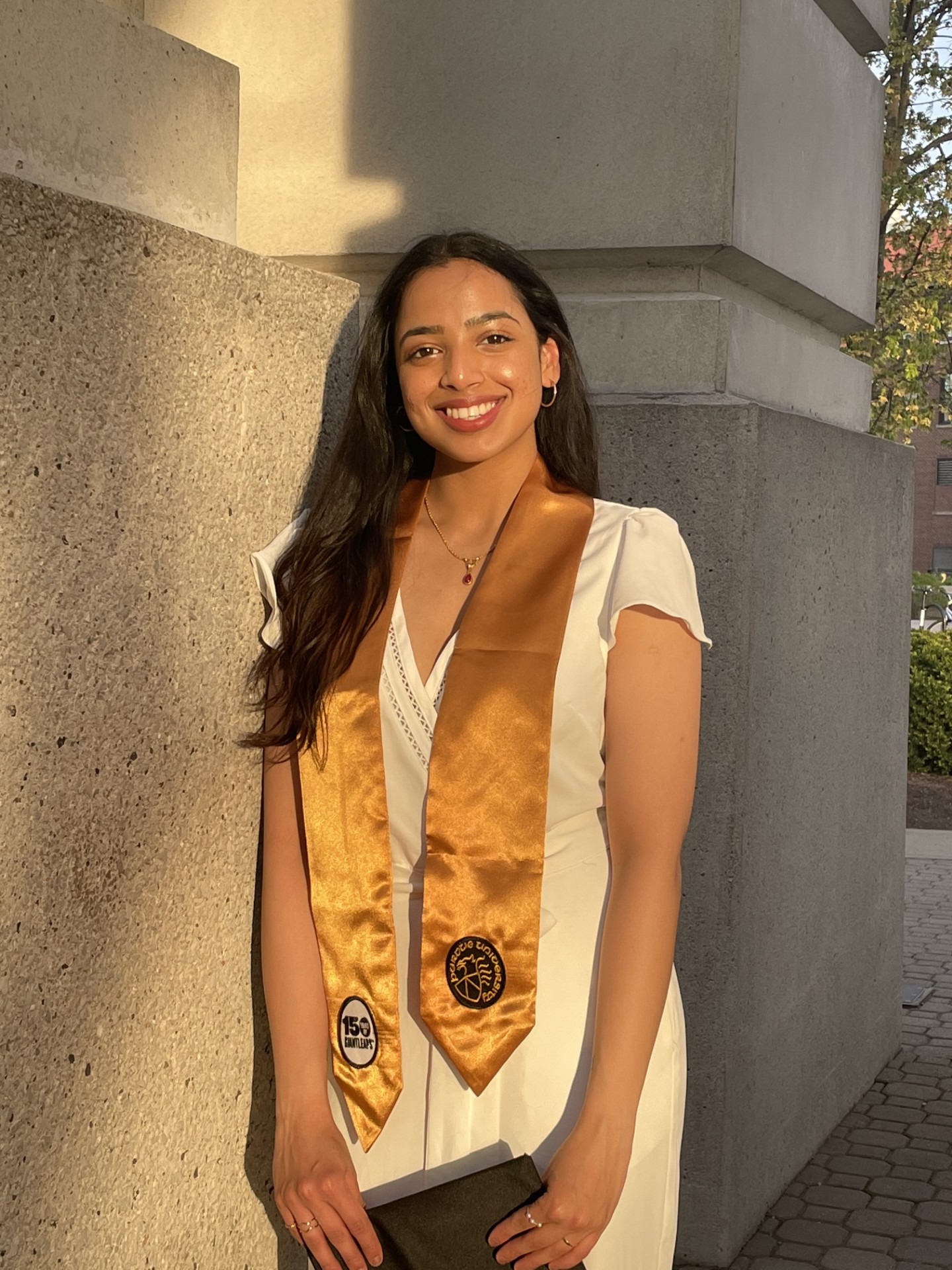
Ashwini Srinivasaprasad
Her project, Reality Switching: Understanding the Hidden Costs of Moving Between Virtual, Augmented, and Physical Workspaces, examines how people adapt as they transition between laptops, VR headsets, AR glasses, and physical environments throughout a typical workflow. While these transitions are often designed to feel seamless, Srinivasaprasad’s research reveals that the body and brain may be working much harder than users realize.
Using wearable electromyography (EMG) sensors, Srinivasaprasad measures muscle activity and physical strain during task transitions. Motion capture sensors track posture and movement in real time, while physiological sensors monitor indicators such as heart activity to better understand mental workload and fatigue. Together, these tools act like a window into the body to provide a more complete picture of the invisible demands created by mixed-reality work environments.
“We’re already seeing fascinating patterns,” she said. “Muscles work differently across VR and AR, posture shifts in unexpected ways, and the brain has to work overtime just to readjust to ‘normal’ reality.”
The implications of this research extend far beyond the lab. With technology companies such as Apple, Meta, and Microsoft investing heavily in immersive computing platforms, Srinivasaprasad believes understanding these hidden costs is critical before mixed-reality systems become standard workplace tools.
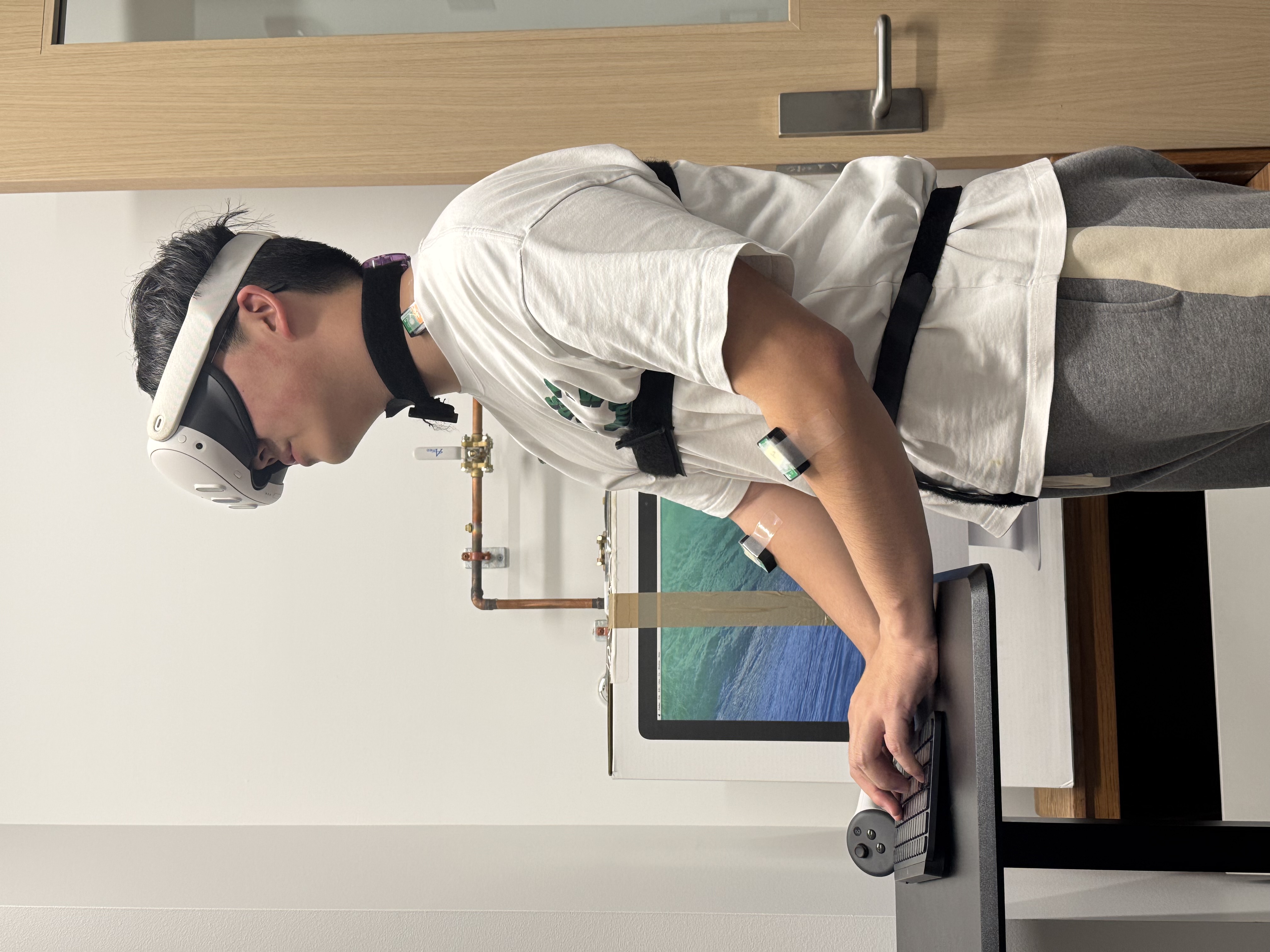
Research participant
“If we don’t understand the impact of switching between realities, we could end up with new forms of strain injuries, fatigue, and cognitive burnout that we’ve never encountered before,” she explained. “My work helps designers, employers, and technology companies create smarter tools and workflows that prioritize human wellbeing.”
Srinivasaprasad’s path into human-computer interaction began through data science. Before returning to Purdue for her PhD, she worked as a Senior Data Scientist at EY, applying advanced analytics to complex business and healthcare challenges. “As a data scientist, I became fascinated by what sensor data can reveal,” she mentioned. “Your body is constantly sending signals about effort, fatigue, focus, and discomfort, often before you consciously notice any of it yourself.”
That fascination eventually led her to VR and AR research, where she found an ideal intersection of biomechanics, cognition, design, and emerging technology.
Purdue IE has played a defining role throughout that journey. Srinivasaprasad earned her bachelor’s and master’s degrees in industrial engineering from Purdue before pursuing her doctorate in IE with an HCI focus, and she credits the program with shaping her interdisciplinary perspective.
“What I love about Purdue IE is that it never lets you forget the human in the system,” she commented. “You can be deep in data, sensors, or simulations, but the program constantly pulls you back to the bigger question of who this is for and how it fits into people’s lives.”
That human-centered mindset is reflected as Srinivasaprasad continues to study how emerging technologies shape human performance. This summer, she will present her project at the Applied Human Factors and Ergonomics Conference and the International Conference on Human-Computer Interaction. This work will also be submitted to Applied Ergonomics Journal. None of which would have been possible without the generous sponsorship from Purdue’s IEEE Systems, Man, and Cybernetics chapter. “I'm deeply grateful, both for the funding and for the community of curious, supportive people that comes with it,” she acknowledged.
Outside the lab, Srinivasaprasad enjoys weightlifting, swimming, pickleball, and spending time with her dog Felix, who remains unimpressed by her research– although he is supportive in his own way, she says.

Ashwini Srinivasaprasad and Felix
After graduation, Srinivasaprasad intends to make further impacts upon the field of Human-AI interaction by becoming a Research Scientist. As mixed-reality technologies become more prevalent for the evolving workforce, Srinivasaprasad’s work represents an important step toward understanding how people, not just systems, adapt to the changing future of work.
Author: Brenna Losch