PhD Student Ching-Yu Cheng Receives Best Poster Award
PhD Student Ching-Yu Cheng Receives Best Poster Award
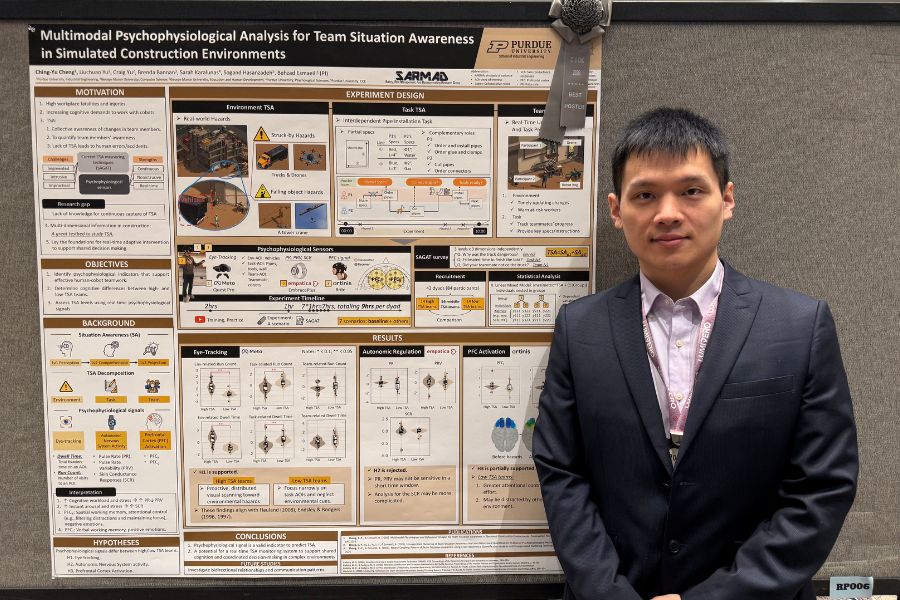
In high-risk environments, worker safety can be compromised in a matter of seconds, and one moment of distraction can lead to fatal human errors. Ching-Yu Cheng, a PhD student, presented a solution to this at a recent conference. For his informative and detailed visual, titled “Multimodal Psychophysiological Analysis for Team Situation Awareness in Simulated Construction Environments”, he was awarded 1st place poster.
In Cheng’s research, he examined how Team Situational Awareness (TSA) can be predicted from psychophysiological signals. Cheng defines TSA as the collective awareness of situational changes among all team members. To measure it, the research team designed a two-worker-cobot collaboration VR experiment. With 84 people in 42 separate dyads, they simulated a 9 hour pipe installation task across 3 days.
During the simulation, they measured various proposed psychophysiological indicators of TSA:
- Eye tracking to determine a participant’s Situational Awareness of area of interest
- Autonomic Nervous System Activity (including pulse rate (PR), pulse rate variability (PRV), and skin conductance responses (SCR) to determine a participant's workload and instant arousal
- Prefrontal Cortex Activation to determine a participant's decision-making process and attentional control
Ultimately, Cheng and his team found that psychophysiological metrics can be used to assess team members’ TSA in real time. The results provided a proof of concept for real-time TSA assessment, supporting adaptive feedback for cobot teammates and fostering coordinated decision-making.
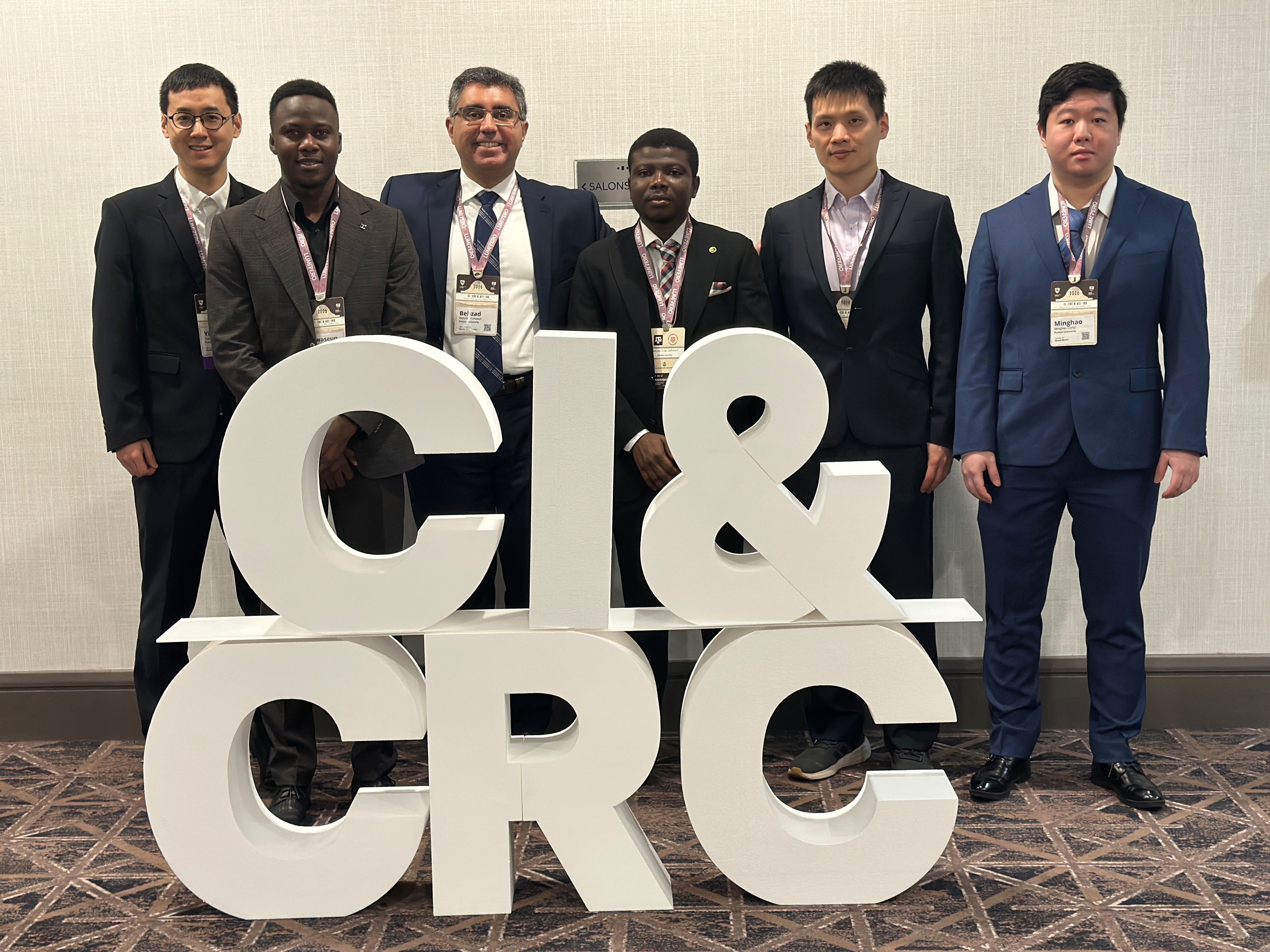
“Receiving the Best Poster Award was very exciting for me. This award indicates that the significance of the research was recognized and supported by the review committee, suggesting the work has the potential to make a meaningful impact on society” Cheng explained. As an international student whose first language is not English, being recognized for this achievement gave Cheng more confidence in his capabilities of communicating research. But more than that, it was a sign that the work he was doing had potential to be incorporated into the real world.
As a PhD student motivated by the opportunity to contribute to society, Cheng has learned how to solve those real-world problems through Purdue Industrial Engineering. Multi-disciplinary courses such as IE 659 (Human Aspects in Computing), IE 577 (Human Factors), IE690 (Sensing Approaches for HF Research), IE546 (Economics Decision in Engineering), etc, aided him in developing knowledge across human factors and decision-making. After all, since this project encompassed a wide variety of disciplines, including construction management in civil engineering, human factors in industrial engineering, psychology, education, and computer science, the knowledge of different fields is essential to finding new solutions.
If he could give one piece of advice, Cheng would encourage current Purdue students to “be active, try everything you like, and do your best.” While engineering itself involves consistent dedication to your goals, it also involves the skill of conveying technical information in a more understandable form. This is an art that Cheng has mastered, as he furthers his research with TSA.