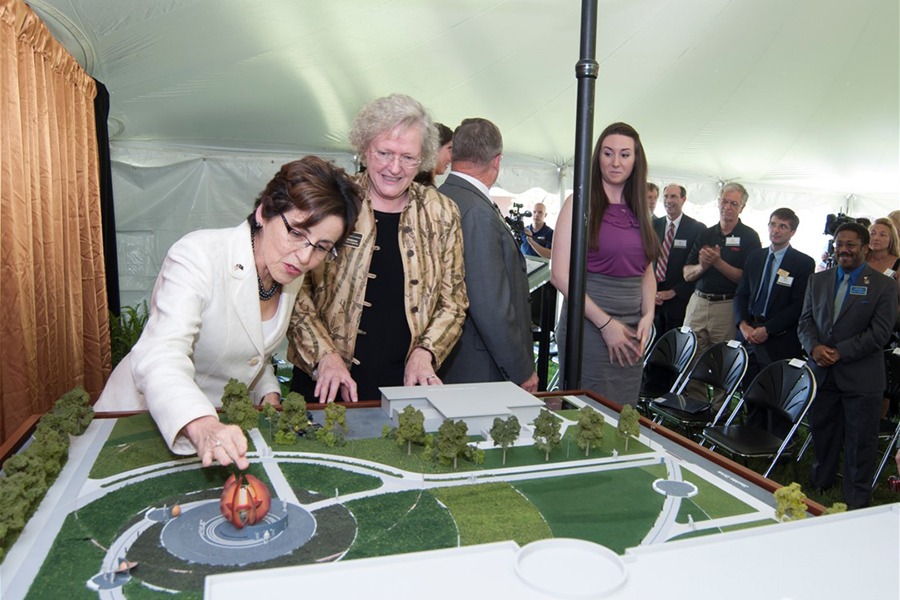
EPICS has been impacting students, communities for 30 years
EPICS has been impacting students, communities for 30 years
A leisurely pace wouldn’t suffice.
Not after what Leah Jamieson just learned.
After two years with a great idea on the cusp of execution, waiting for an avenue to launch a hands-on experiential learning-based curriculum that Purdue University engineering students desperately needed, the solution popped into Jamieson’s mailbox on campus.
Community-connected projects.
That was the missing element Jamieson and fellow Purdue electrical and computer engineering professors Ed Coyle and Henry Dietz had been searching for.
So Jamieson couldn’t sit in her office and just pick up the phone. She couldn’t casually walk up one flight of stairs in the Materials Sciences and Electrical Engineering building to Coyle’s office.
She had to run.
Breathless, she arrived at Coyle’s door, waving the piece of mail she’d just gotten.
“Community organizations could be the source of compelling projects tackling real-world problems,” she told Coyle, inspired by the announcement she was holding from the U.S. Department of Education (DOE) that solicited proposals connecting college students with their community.
By the time Jamieson, Coyle and Dietz submitted a proposal to the DOE’s Fund for Improvement of Post-Secondary Education (FIPSE) program, they had nearly 20 letters of interest and endorsement from local United Way agencies.
A glorious moment, the true beginning of what would soon be named Engineering Projects in Community Service — now called simply EPICS — a transformative program that met an industry need by equipping students with more than just technical skills but also the crucial professional skills that companies desperately sought.
The program would prepare students by getting to the heart of engineering: making a difference in the world by meeting real needs, impacting communities by delivering real projects for real people.
The official journey started in fall 1995 with considerable challenges. Starting a program as substantial as they’d dreamed from scratch, with hurdles rising up that they literally hadn’t even imagined, was hard.
As engineering should be. As executing dreams that matter tend to be. As trailblazing tends to be.
There were doubts along the way. Discouragement, too. There also was rugged endurance, enthusiasm and ridiculous energy, oftentimes fueled by students who reflected the promise of the program and its intention.
“EPICS creates a really powerful opportunity to make the point that engineering is about helping people, making the world a better place, serving people, so that philosophy part, which we stumbled on because they were looking for proposals, resonates and continues to resonate,” Jamieson said of the program, which started with 40 students in 1995 and, 30 years later, has more than 1,000 in West Lafayette and Indianapolis.
This is the story of the Purdue University-led charge for EPICS.
‘Something had to change’
When a problem is presented, a true engineer seeks a solution with a persistent pursuit.
In the early 1990s, Jamieson and ECE colleagues at Purdue started hearing the criticisms being lobbied at engineering programs for graduating students with very few of the professional skills companies were starting to value: communication, team experience, project management, customer awareness, professionalism and ethics.
In Summer 1992, about half-dozen faculty in electrical engineering got together to discuss how they could change that. A request for proposal from GE focused on education spurred the assembly of that committee.
The structure of EPICS grew out of those conversations.
The key points from those early discussions were to pursue vertically integrated projects with teams of sophomores through seniors, for credit, over multiple semesters. But what projects would be compelling enough to keep students coming back semester after semester?
Coyle had been teaching a junior-level course in electrical and computer engineering for a few years at that point, and when students would stop by his office to ask for help or for advice, he would ask if they were working on any cool projects outside classes. He kept getting a similar response: There’s no time to do anything like that.
“It was clear that something had to change in the curriculum because we were crushing the life and enthusiasm out of our students,” Coyle said.
The faculty group tried approaching potential industry partners with the idea, but the multi-semester timetable wasn’t a good match for projects industry typically sponsored at universities.
“It was tricky because there really wasn't anything like EPICS before, so almost everything we were trying to do was breaking new ground in some way,” Dietz said.
They were stuck for almost two years.
Jamieson, Coyle and Dietz stayed the course, periodically revisiting ideas the team had generated while they were trying to solve the source of the compelling projects puzzle.
And then Jamieson saw the FIPSE call for proposals.
“I think it is the only time in my life that a light bulb appeared in front of my eyes,” Jamieson said.
And then the dash to Coyle’s office.
Turned out Coyle had a relevant piece of mail in his desk drawer, too: A fundraising flyer from United Way, with its contact information.
Coyle scheduled a meeting with United Way agency directors, and in the initial conversation, he described an Automated Assistance Center (AAC), a kiosk that a person in need could walk up to and ask questions to a computer to identify which agencies in Lafayette could provide appropriate help.
The directors were excited about long-term projects like that, Coyle said, and one of them wanted to be the “owner” of the AAC project.
They were excited, too, to have teams they could work with for several years on big projects, instead of the traditional help of a student volunteer or two who may be connected for a while but then leave.
Coyle asked the directors to send him letters describing projects they would like Purdue teams to do.
Within a week, Purdue had nearly 20 letters from agencies.
The letters were included in the proposal to FIPSE, and that support helped land the $70,000 grant. The College of Engineering agreed to match the funds.
And the program was born. (The name came a bit later, thanks to Dietz and an acronym-generating software he had written.)
Felt a bit like 0-60 mph after sputtering for two years.
“The community made it happen,” Jamieson said. “From the start, it was an essential part, and it continues to be an essential part because there’s a set of values associated with supporting community. There are some things it turns out students are really good at but also don’t get to practice much in the academic setting, which is that budgeting is critical because agencies don’t have a lot of money. For this, we never expected the agencies to pay for the projects. But it was still a part of saying, ‘Who’s your customer? What are you doing?’ and knowing you were doing something that long term should be affordable was important. So in so many ways, the community made it so EPICS could get started, and it has stuck with us for 30 years.”
Overcoming
The excitement of becoming “official” was soon tempered by the realization of how much needed done to set up and run a program like the co-founders envisioned.
Coyle, Dietz and Jamieson submitted a proposal to electrical engineering to offer an experimental course in the fall 1995 and created an official syllabus, milestones, schedule, grading process and guidelines — steps needed to launch a new course.
Except they didn’t have a template for this kind of course.
Getting the first course description together was a hurdle, and that included skepticism from some faculty, Jamieson said. Not surprising, maybe, considering professors in EPICS courses wouldn’t have the same control as in a traditional lab. Typically, professors and TAs work to craft a well-constructed lab with specific learning outcomes for students. But in the new program, community partners were the source of projects and shaped what technologies might be needed and what students learned.
Creating and registering for a set of variable courses — that students could take and receive credit every semester instead of a traditional three-credit course — also meant negotiating with the registrar’s office. And every section was a team working with a different community partner. Unlike most courses, it made a huge difference what section a student was in.
Standard registration software systems don’t work that way.
“It took a long time to work through that,” Jamieson said. “We tried a lot of different things in different semesters to see what would go smoothly. But, at the end, students were able to register for EPICS. They could get into the section they wanted to. Their credits would be awarded appropriately. But it was a daunting challenge and required a lot of meetings every semester for a very long time.”
After Jamieson connected with one of the high-probability potential project partners at Purdue; Coyle followed up with United Way agencies; and Coyle and Dietz rented a truck and drove to Chicago to accept a gift of two pallets of shrink-wrapped prior-generation desktop computers for lab equipment, they thought they were ready.
But there also was no roadmap on how to teach the courses they’d created.
Forty students — 39 electrical engineering majors — registered for five sections that first semester. Coyle, Dietz and Jamieson co-taught and co-advised all five.
Why all five?
They knew enough to know they may not know anything.
“There was strength in numbers,” Jamieson said. “The fact that it basically allowed us to make decisions together helped a lot. Sometimes we’d say, ‘We’ll get back to you on that.’ Sometimes, we just had to regroup on the fly. Just being able to do that together with different perspectives made it work really well.”
Even in the midst of that “blur” of a semester, Jamieson knew what they’d created was special.
And could last.
“I suspected that it might last because it just felt right. I would walk down the hall of the EE building, and for that whole semester, it felt like my feet never touched the ground,” she said. “Things were clicking, and you could see the enthusiasm in the students.
“Their passion would refresh ours when we found ourselves asking, ‘What in the world are we doing?’ … With these students, you just couldn’t think that for very long because they were making it happen. Also, there were times when other people asked us that: ‘What are you doing?’ So it was really amazing to have this group of adventuresome, excited, enthusiastic students who loved what they were getting a chance to do.”
That energizing vibe from the students — “so” energizing, Jamieson said, holding the first word for a couple seconds for emphasis — was a main reason they all made it through, that first semester.
But iron-willed commitment by the co-founders was key, too.
Jamieson already was scheduled to teach another course that semester, in addition to other expectations of a fully tenured faculty member.
Dietz already was teaching an overload, so EPICS was an additional teaching overload. He primarily was responsible for making sure students had facilities that could support building real things involving hardware and computer software as well as mechanical systems, training the students to use those facilities and “sanity checking and nudging to ensure that each of the projects was feasible and wouldn't end up failing.”
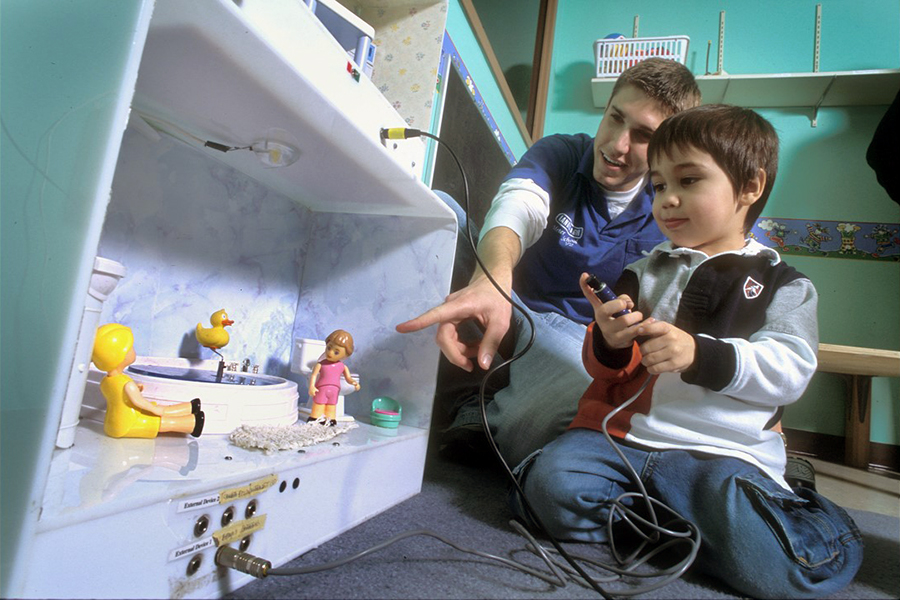
“Honestly, it worked only because everyone involved in the early years of EPICS believed it was worth quite a bit of personal sacrifice,” he said. “We did it because we saw it not only as giving students a better capstone experience but also as a way to leverage our expertise to help the Greater Lafayette community.”
Finding space to teach was a constant challenge in the first years of the program, not only because labs needed to be used by students for long hours and into the evening and on weekends but also because each lab, each section and each team had a scheduled two-hour lab time in the week in addition to a formal expectation to get together outside of the lab to work on the project.
Electrical engineering professor John Lindenlaub, excited to see a new venture centered on education, gifted the first EPICS lab, on the third floor of the EE building. The lab served as a computer lab and the meeting space for the scheduled weekly class meetings of each of the five teams. Early EPICS leadership also ultimately worked to get a meeting room in the Physics building and another space in the College of Education. For several years, space was leased off campus at an old grocery store on the Levee Plaza. It was not convenient, considering it oftentimes required students to carpool, but it was more space than needed. In that sense, it was a luxury.
Until the real one came along.
“One of my happiest moments of EPICS planning — I represented EPICS on the committee that was planning what was initially called the Millenium Building but became Armstrong Hall,” Jamieson said. “I was on the committee for seven years. Some of the time went into trying to answer questions about how you design labs for projects whose needs will vary by project and will change over time, and some of whose needs won’t be known until years after the building opens. But I spent much of my time on the committee making the case that EPICS is doing great so it would be really good if it could have really visible, really wonderful space. And we got it.”
By then, in 2007, the program had grown to 300 students per semester.
And, by then, the scope had changed.
Oakes’ arrival
William Oakes won’t soon forget the first time he heard about a program at Purdue called Engineering Projects in Community Service.
Mostly because he thought it was not “real” engineering.
As a jet engine designer who’d recently come to Purdue in pursuit of a PhD in mechanical engineering, Oakes was in a room with several other students interested in engineering education in 1996 when mentor and mechanical engineering professor Jim Jones brought in Ed Coyle to tell them about EPICS.
“My view of proper engineering were industry projects. I’m like, ‘How’s this going to work? How are these real engineers?’ ” Oakes said.
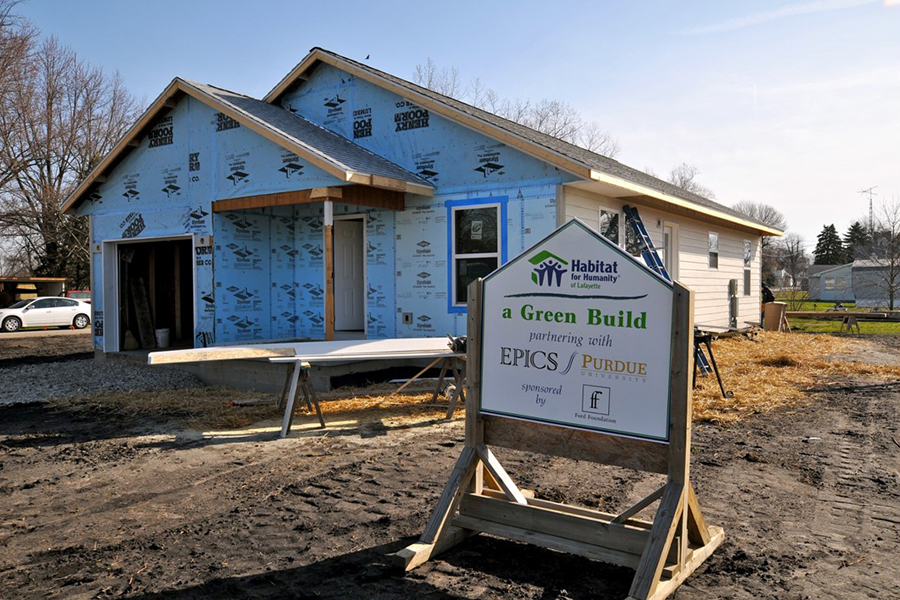
In 1998, Oakes joined the faculty of the Department of Freshman Engineering after completing his PhD. Bob Montgomery, an associate professor in Freshman Engineering, approached Oakes with a proposition. EPICS had secured a single-institution Learn and Service America grant, a then-government program under the Corporation For National and Community Service. It was a three-year grant, but in order to get each additional year, the recipients had to do something a bit different. Montgomery had represented the department in securing the grant funding, and now it needed someone to teach EPICS and expand it to include first-year engineering students.
Montgomery thought Oakes would be better suited with Oakes’ design engineer background. Montgomery also was a more senior professor and wanted to give an assistant professor an opportunity, Oakes said.
Oakes’ interest was piqued primarily because his mother, Susan, was a social worker at the time. He thought, “Oh, she’s going to be so happy.” But his thoughts hadn’t changed.
“It’s like, here’s the real engineering stuff on the industry side. Here’s this community stuff, it’ll be all cute,” he said.
Still, Oakes agreed to advise two EPICS teams, Imagination Station and Habitat for Humanity.
Soon after, Oakes loaded up the Habitat team for its first community partner visit with Doug Taylor, a founding member of Habitat’s Lafayette chapter. And nearly got fired upon arrival.
“I don’t think Habitat and EPICS fit very well. I think we need to stop,” Taylor told Oakes in front of the EPICS students.
Taylor wasn’t wrong, Oakes said, because, to that point, the team hadn’t used appropriate technology for the Habitat context. Though Oakes was shell shocked by Taylor’s revelation, Oakes’ industry background had engrained that if a customer wasn’t happy, it was time for a pivot.
Because it was the late 1990s, Habitat was doing all of its drawings on paper. Oakes’ suggestion was for Purdue’s Habitat team to put drawings in computer-aided design software, so Habitat could see them in 3D. The EPICS team also did energy modeling, allowing the Habitat team to see what it would cost to operate each of its home plans.
“They thought it was valuable, and we’ve worked with them ever since,” Oakes said.
The more Oakes worked with EPICS, the more he noticed a change in the students. He’d hear them complain they had teammates that didn’t work hard enough, that wouldn’t get things done, that they constantly had a report or presentation due, that partners couldn’t make up their minds or kept changing requirements. That’s exactly what Oakes and his colleagues complained about when he was a design engineer.
And that made him a believer.
“It flipped my thinking of engineering education, actually,” Oakes said. “Because what I realized is our job is not to do something that looks like what they will do, our job is to give them the fundamental tools. It’s just like we make them take a calculus class. Not that they’re going to do calculus later, but it’s a fundamental skill they’re going to need.
“The key is we’re with a real partner that needs their design. It’s also within the students’ capabilities, and it’s something they find meaningful. They get invested so they’re not begging for points. They’re more concerned about getting the thing done.”
About two-thirds through Oakes’ first semester with EPICS, he was approached to expand his involvement. Coyle had been asked by Purdue’s provost to help launch a large joint research program involving Purdue, Motorola and Los Alamos National Labs. EPICS was going to need another co-director with Jamieson, while Dietz primarily ran labs and managed software projects.
After getting advice from then-dean Richard Schwartz, Oakes accepted the new role.
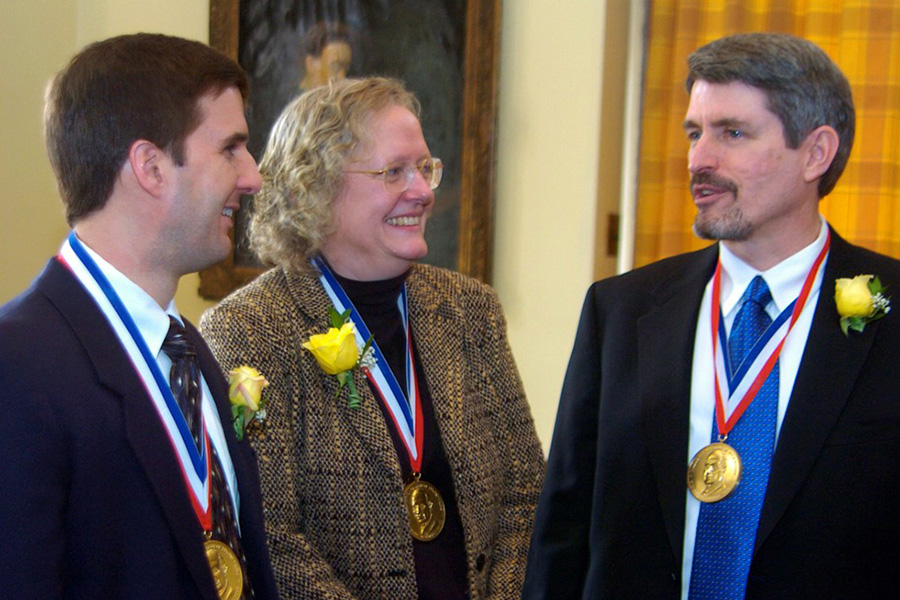
(From L-R) Bill Oakes, Jamieson and Ed Coyle were awarded the National Academy of Engineering's Bernard M. Gordon Prize in 2005.
When Jamieson moved into an interim dean role with the college in 2006, she stepped back from EPICS, and Oakes moved in as interim director. The “official” director role came in 2007, a year after Jamieson was appointed the John A. Edwardson Dean of the College of Engineering and the same year EPICS moved into the new Neil Armstrong Hall of Engineering.
Oakes brought a couple important pieces with him to the new space.
After receiving four external awards and even more internal awards in the program’s first five years, a truly special one arrived in 2005, when the program had 400 students working in 20 teams.
EPICS and leaders Coyle, Jamieson and Oakes were awarded the National Academy of Engineering’s Bernard M. Gordon Prize for Innovation in Engineering and Technology Education. The award was (and still is) the top prize in the world in engineering education.
“We knew we had been nominated, but it still seemed incredible. Just blown away,” Jamieson said.
The award came with $500,000, usually split between the institution and the recipients. Jamieson, Oakes and Coyle declined most of their share, opting to put the bulk toward the program.
EPICS expands
From the beginning, Coyle knew EPICS could be broader than Purdue.
The idea was too good not to share, and what other university would be better suited to lead such a charge?
Into other universities and, even, high schools.
At the university level, Iowa State and Notre Dame were the first to show interest in adding EPICS in the late 1990s, and, over the years, more universities were added, spurred in part thanks to a National Science Foundation (NSF) grant with Coyle as PI. Now, it’s grown to a consortium with international connections, adopted by more than 40 universities and colleges.
“A big part of it was it was the right thing to do. Here’s a way to get students better prepared. It’s a way to meet needs in the community. To me, it’s something I’m actually proud of Purdue for supporting,” Oakes said. “What has happened is Purdue has become recognized as an international leader in this, so it’s good for the reputation.”
After three EPICS alums approached Coyle in 2003 and said they wished they’d had EPICS in high school, Coyle instigated expanding the model into that space. He helped fund Bedford North Lawrence High School, and its first team had 17 students, 14 of whom were women. EPICS alums Sarah Armstrong and Jill Heinzen were mentors for the team, and after only three years, the group filed for its first patent, Oakes said.
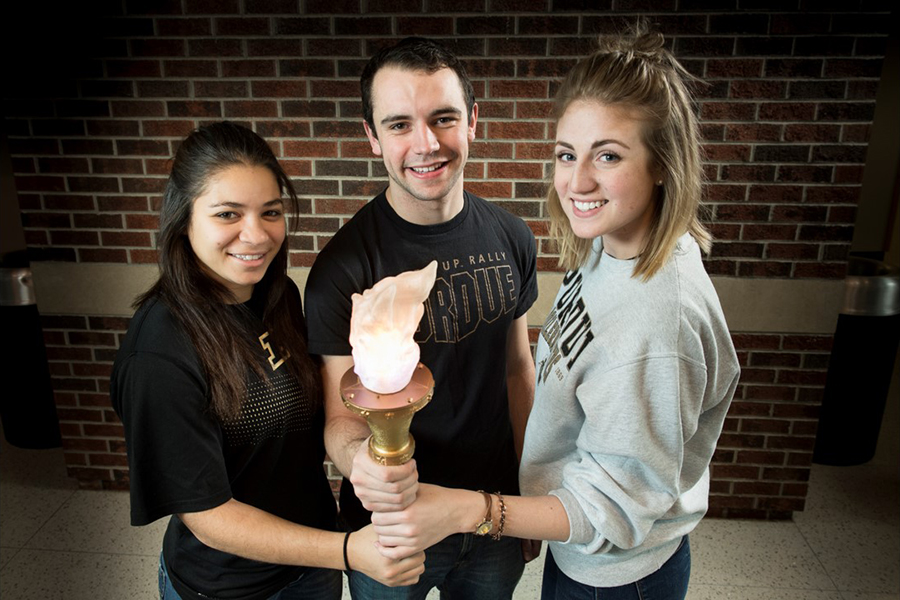
By then, in 2006, Purdue had secured another Learn and Serve grant (its third) to expand the K-12 program, which now has more than 100 connected middle and high schools in 17 states plus Washington D.C.
In 2009, the Institute of Electrical and Electronics Engineers (IEEE) launched “EPICS in IEEE,” built around IEEE local sections around the world. To date, it has engaged 1,600 IEEE volunteers and 1,300 student volunteers, delivered over 300 projects and impacted an estimated 1.6 million people.
“When Leah and Ed started, there was a question, ‘Can engineers actually work in the community? And is community work appropriate for engineering?’ What I think is neat, because of success we’ve had and others, both are accepted,” Oakes said.
Oakes has led more than 130 workshops about how to get an EPICS program started, traversing across the globe to visit every continent with an engineering program. (For the record, that’s six of the seven: There wouldn’t be much of an audience in Antarctica.) Many of those workshops have been funded through grants, both from Learn and Serve America and NSF.
One of those workshops was at the University of Michigan where Oakes’ mother had earned her master’s in social work. Because of the connection, Oakes swung by Battle Creek, Michigan, on his way to Ann Arbor to pick up Mom so she could attend the workshop.
On the drive home, she turned to him.
“I can retire in peace because I know you’re carrying on my work as an engineer,” she said.
Oakes had to pause.
“I never would have connected what I did with her,” Oakes said. “So (EPICS) becomes an ‘and.’ There are so many things we look at that are ‘ors.’ It’s like, ‘Can I develop those technical skills? And those professional skills that I need? And meet a community need to be prepared out there?’ Usually it’s an ‘or.’
“EPICS, really, is an ‘and’ to do that.”
Lasting impact
EPICS hasn’t shown signs of slowing down, 30 years in.
It is one of two pathways for first-year engineering students at Purdue University in Indianapolis, which launched July 1, 2024, and 269 students were enrolled in the program in fall 2025.
The Learning Community in West Lafayette, which Oakes initially pitched and was established in 2010, has a wait list of more than 1,000 students.
But when Oakes was asked to write material for the ASEE Hall of Fame for both Jamieson and himself in 2024, Oakes took a step back and reflected on his nearly 28-year connection to the program. A connection that he’s called “the best job in the world, being able to explore how we make the world a little better each day in a tangible way.”
What he understood, fully, was that impact isn’t just one thing.
“There are numbers, and there are people,” said Oakes, who transitioned from EPICS director to associate dean for undergraduate education in Purdue’s College of Engineering in 2024. “When we were just looking at numbers of students who have been impacted, it’s tens of thousands. When you look at the number of people who have benefitted from the work, it’s actually in millions, directly and indirectly.
“That kind of takes your breath away.”
But, when Oakes thought about it, he knew it wasn’t just numbers.
It’s about a project for an individual kid who had a severe disability and couldn’t use his arms. And an EPICS team designed things to allow the boy to feed himself for the first time. And dress himself.
It’s about a project for a 22-year-old single mother with a 3-year-old toddler, to build a house through the EPICS Habitat team — the one that almost got fired on its first visit. A house that stopped being called the “sustainable” house but her house. A house that ultimately changed how houses were built across Indiana for Habitat for Humanity.
It’s about a project that allows a child with severe cerebral palsy who uses a wheelchair to be a captain of an accessibly designed sailboat. A sailboat designed for Bradford Woods, an accessible summer camp in Indiana, that so wowed GE Aviation’s chief engineer on a visit to Purdue that he wanted to hire the EPICS student lead on the spot.
It’s about a project that addresses food sovereignty on the Pine Ridge Reservation, home to the Oglala Lakota Nation. Purdue incorporated acyclic sheets from the COVID era into a design of a greenhouse roof and above-ground wall panels and shipped approximately 500 acrylic sheets to partner Oglala College.
“There are hundreds of examples like that,” Oakes said. “We do these workshops, and a lot of times I think what we do is give people permission to do this. Because it’s like, ‘Is this proper?’ It’s one of the advantages of being from Purdue because no one can say, ‘Well, you’re not a real engineering school.’
“It’s some of the brilliance as having Purdue as a lead. We’re a heavy duty, highly ranked research university, and the fact we do this I think would give anybody else permission to go do that.”
EPICS is celebrating 30 years of impactful service and hands-on engineering design to Purdue University, undergraduate students and the local and global community. Keep up with EPICS news on the anniversary page, and support future EPICS students by becoming a partner or making a gift.