Nottingham Middle students design adaptive pencil for classmate through EPICS program
Nottingham Middle students design adaptive pencil for classmate through EPICS program
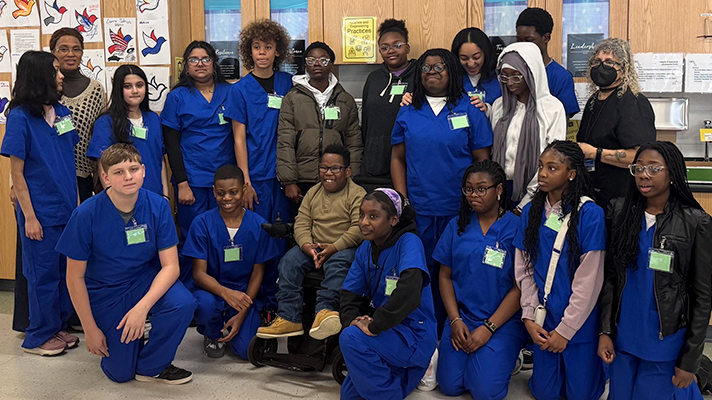
First period was packed on the day of Ruth Akers’ seventh-grade EPICS presentations.
What stuck out to Akers was not how many students were there, but that five parents were squeezed into middle schooler-sized desks, eager to learn about what their children had designed in the health science program at career and technical education (CTE) Nottingham Middle School in Baltimore.
“Most of those parents are at work during first period,” Akers, a first-year health science teacher but longtime CTE teacher, said. “It was touching to see how many came and supported the kids. That’s how I know this was a big deal.”
Akers received her annual email from Charese Williams, EPICS assistant director of the EPICS K-12 program, calling for project pitches for EPICS and a Purdue-provided project design kit, tailored to the need of the pitch. And Akers immediately thought of Isaiah, an eighth-grade student with Lowe Syndrome, a condition characterized by eye, brain and kidney problems due to a missing essential enzyme. She knew Isaiah wanted to improve his handwriting and, with low muscle tone, he would need a steady gripping tool to achieve that goal.
It didn’t take long to convince his mother, functional learning teacher Alaynna Browning, that Isaiah’s goal had plenty of potential for a meaningful EPICS project.
Both Akers and Browning were delighted when the materials arrived, courtesy of EPICS and their longstanding partnership with Motorola Solutions Foundation: a variety of foams and soft materials, a grip weight and a hot glue gun. The students would have the opportunity to design, test and present an adaptive pencil for Isaiah.
The project was an exciting hands-on opportunity for the seventh graders. But Akers worried. Her students had never documented research. Or built prototypes. Some hadn’t ever given presentations. How would they handle so much new information being thrown at them all at once — and with only six weeks between receiving the materials and presenting the project?
With enthusiasm, Akers found out quickly. Once the teams met Isaiah, who was just a few halls away in Nottingham, they dove into the projects with bright eyes and a spectrum of ideas. Akers let students choose their own groups — which can be a dangerous game, as any educator knows — but the 19 groups worked with creativity and focus.
And, with a few reminders, each team documented progress for the presentation that came at the end of the process.
“They didn’t balk at the design process, even though most had not been exposed to that before,” Akers said. “I was worried that they wouldn’t be geared up to do this process — the documenting, the journaling and everything unless they were able to connect the project to a person.”
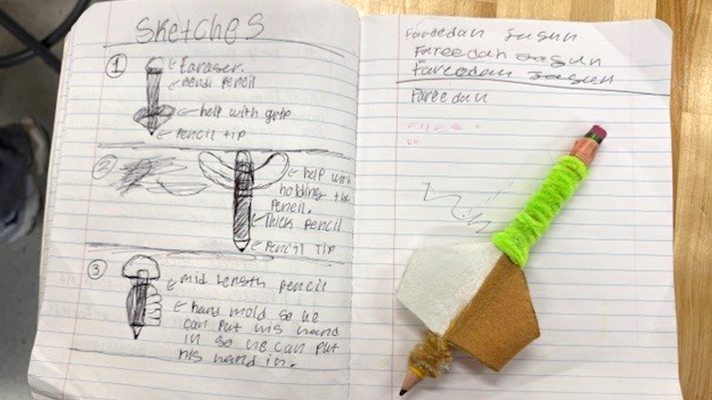
Akers taught each team about experimental design, including a design matrix of criteria that would help students discern the best prototype. The deliverable had to fit in Isaiah’s hand, be completed by the presentation and use the materials received in the EPICS kit. The teams rated each prototype’s effectiveness on a scale from one to five to find the best fit — the one with the highest score.
Teams created designs as complex as a joystick and a straightforward as a foam grip. Shine’s team gathered information from Isaiah and tested a prototype with a surprisingly similar model: a baby’s hand.
“I got the idea to use my nephew’s hands for our prototype because Isaiah’s looked a lot like them,” said Shine, a seventh grader whose group created a fabric grip. “We watched the way his hands gripped on a pencil, and it helped us make sure that the grip would be comfortable.”
Anthony’s team created a joystick model that includes a foam stand that will go under Isaiah’s hand. He can use the stand to move a pencil in a foam sleeve to write without difficulty.
Seventh grader Maya noted that Isaiah’s pencils are thick and short, which helpfully narrowed down what kind of grip her team could design. The grip had to fit both around the thick pencil and comfortably within Isaiah’s hand — and, since Anthony’s group was designing a joystick model, Maya’s tried something different.
Maya’s team started testing materials for a handheld grip.
“The prototype we chose was cotton because we wanted it to be soft, but then it wasn’t as comfortable (for Isaiah) as the foam,” said Maya, who presented the project’s design process to her classmates in February 2026. “So we put the cotton inside a little foam wrap we made so it would be more comfortable to use.”
Akers was impressed with how well the students managed their project time, including when the Baltimore school had two surprise snow days during a nor’easter in January 2026. They only had three 50-minute periods each week. Feedback from Isaiah’s near-weekly visits to the teams would substantially change material or shape of a prototype. But the projects were still complete on the day of the presentation, with 19 deliverables showed off to parents and classmates before finally going to Isaiah.
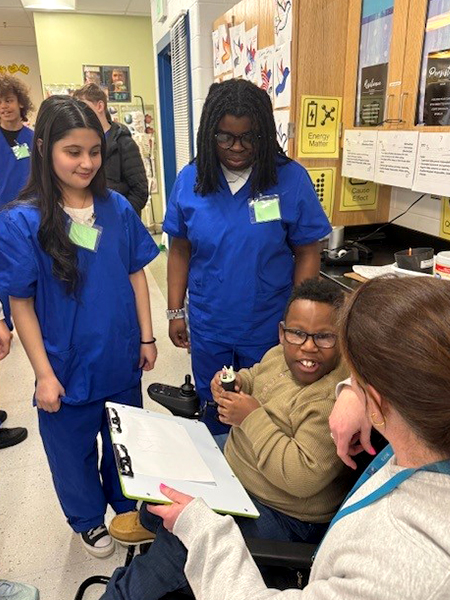
The prototypes that best align with Isaiah’s needs will stay with him. The rest will fulfill needs for other students in Isaiah’s classroom who also need assistance with writing.
Isaiah’s face lights up when he talks about the pencils that his friends in another classroom made for him, according to mom Browning. Both Browning and Isaiah’s newfound friends down the hall noticed his handwriting improve with the grip, meeting Isaiah’s goals to have a comfortable and supportive way to succeed.
“For me, this project was two-fold,” said Browning. “On the parent side, anything to support my child and his quality of life is amazing. And as a functional learning teacher, that connection and bridge is important to me. Even though Isaiah’s in a wheelchair and is very participatory, he still feels invisible. So to have that connection with general education students has been amazing to him. I want (the EPICS) students to understand what’s going on in our classroom, so that students with disabilities can still learn and read and write. They just have to get to know them, stop by and see what we’re up to.”
Isaiah’s adaptive pencil is the first of many EPICS projects at Nottingham, Akers and Browning hope. The seventh-grade class feels the same. EPICS at Purdue’s provided materials, combined with a rich middle school imagination, inspired students to create — and look for ways to keep creating.
“We'd like to do more of this project in the future because we like to put a smile on somebody's face,” said student Machai. “Doing the work and knowing that we're going to make somebody happy and help them with their daily lives of comfort, that’s what we’re all about.”