
NASA's Gravity Probe B Confirms Two Einstein Space-Time Theories
NASA's Gravity Probe B Confirms Two Einstein Space-Time Theories
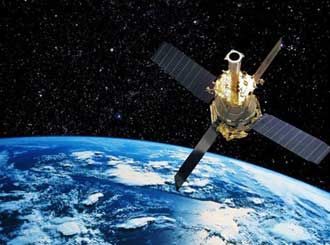 After 34 years of research and development, 10 years of flight preparation, a 1.5 year flight mission and 5 years of data analysis, NASA’s Gravity Probe B (GP-B) mission has confirmed two key predictions derived from Albert Einstein’s 1916 general theory of relativity, which the spacecraft was designed to test. The findings are online in the journal Physical Review Letters.
In the early 1990’s Prof. Steven Collicott and a number of students had the opportunity to be part of this exciting work. GP-B advanced the frontiers of knowledge and provided a practical training ground for 100 doctoral students and 15 master's degree candidates at universities across the United States. Purdue's role on the team is documented in:
- MS thesis: Robert Bayt, "Prediction of End-cap Effects on Equilibrium Helium Bubbles in the Gravity Probe-B Spacecraft", 1995.
- Undergrad AIAA research paper: M. Stephen Krautheim
- Conference papers also involved grad students Scott Courtney and Yongkang Chen
The experiment was launched in 2004, used four ultra-precise gyroscopes to measure the hypothesized geodetic effect, the warping of space and time around a gravitational body, and frame-dragging, the amount a spinning object pulls space and time with it as it rotates. GP-B determined both effects with unprecedented precision by pointing at a single star, IM Pegasi, while in a polar orbit around Earth. GP-B completed its data collection operations and was decommissioned in December 2010.
Innovations enabled by GP-B have been used in GPS technologies that allow airplanes to land unaided. Additional GP-B technologies were applied to NASA's Cosmic Background Explorer mission, which accurately determined the universe's background radiation. That measurement is the underpinning of the big-bang theory, and led to the Nobel Prize for NASA physicist John Mather.
The drag-free satellite concept pioneered by GP-B made a number of Earth-observing satellites possible, including NASA's Gravity Recovery and Climate Experiment and the European Space Agency's Gravity field and steady-state Ocean Circulation Explorer. These satellites provide the most precise measurements of the shape of the Earth, critical for precise navigation on land and sea, and understanding the relationship between ocean circulation and climate patterns.
The entire account of Gravity Probe B with fact sheets can be found on the following web sites:
http://www.nasa.gov/mission_pages/gpb/
http://einstein.stanford.edu